
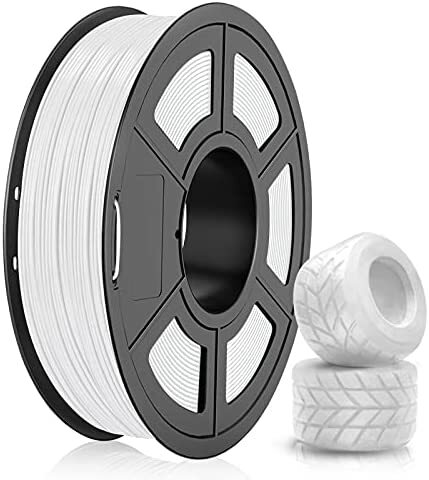
*Once ordered Cura profile with initial configuration for this material will be available for download.
Features:
- Flexible material with the same elasticity as rubber.
- The thinner and less filled the printed model is, the higher elasticity and softness it gets.
- Low viscosity, easy to cool.
- Uv Resistant.
- High Quality: Good toughness, low shrinkage, and superb layer bonding. No bubble or dust inside neatly rolled to reduce clog or tangling.
- Wide Compatibility Full mechanical winding and strict manual examination, guarantee the TPU filaments are tidy and easy to be fed.
Hard plastic may be a popular material, however in some situations, it can be less than ideal or even completely unsuitable. Whether you need a phone cover, an action camera case or wheels for your RC car, flexible is the way to go.
The family of flexible filaments is called TPU (ThermoPlastic Polyurethane). The flexibility of this filament is its most noticeable feature. TPU is not only flexible, but it is also extremely sturdy and difficult to break. It can absorb a lot of impacts, so it’s a great filament to use if you need something tough. Its toughness extends to its capacity to tolerate a variety of conditions. This means it can withstand water, fire, and oil. TPU is your best pick if you need to print something that needs to be flexible, sturdy, or resilient.
First, clean the nozzle of previously extruded plastic. Next, you’ll need to empty the hotend of any plastic left inside. Normal unloading will leave some filament inside and TPU will have a very hard time pushing it out. So either do a “cold pull”, where you preheat, insert PLA, set the temperature to 85°C, loosen the idler completely and pull the filament out rapidly. Or alternatively, if you have 1.5mm wire around, you can just preheat and push the filament out with the wire.
Before you actually load TPU, loosen the extruder (idler) screws a bit. After that, you’re good to go. Flexible filaments can bond to the bed too much, especially to PEI. To prevent damage you might need to use glue on the bed as a separator (you can use the glue stick that we ship with each printer).
TPU has very good abrasion resistance, remains flexible in cold environments, and is resistant to many solvents. It doesn’t shrink much when cooling down, so you can be fairly accurate with your measurements and perfect fit models.
TPU Filament Specifications:
- Diameter: 1.75mm.
- Dimensional accuracy: ± 0.05mm.
- Nozzle temperature: 190-220 ° C.
- Bed temperature: 0-60° C is recommended.
- High quality and compatibility.
- Environmentally friendly 3D printer consumables, high performance, no bubbles, no plugs.
- Compatible with 3D printers using 1.75mm diameter consumables with a dimensional accuracy of ± 0.05mm.
Reviews
There are no reviews yet.